

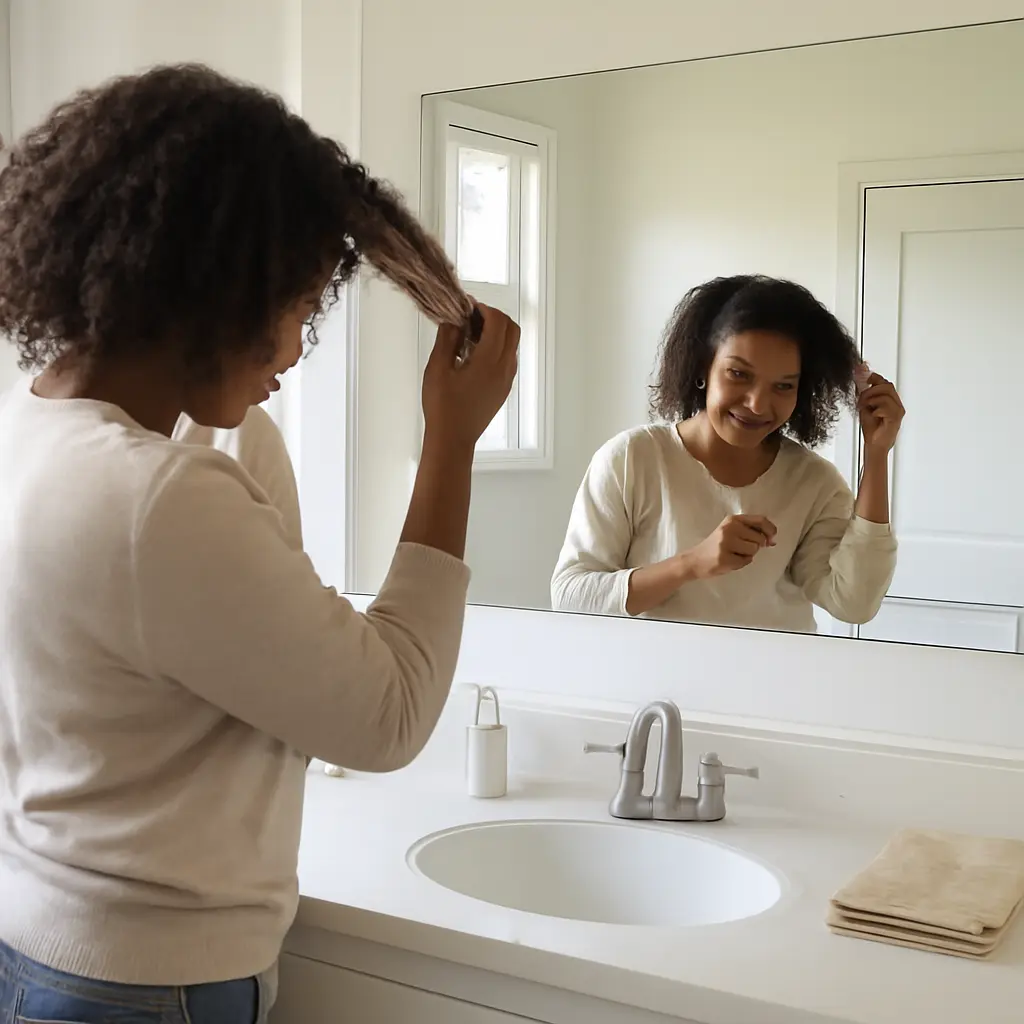
Hair texture is the natural pattern and feel of hair, shaped by factors including curl formation, strand thickness, and how the hair responds to moisture and styling. Working with your texture means choosing care and styling practices that support those traits instead of repeatedly trying to make them behave like a different hair type. The American Academy of Dermatology (AAD) advises gentle, texture-aware care because tightly curled hair can be more prone to dryness and breakage. Understanding curl patterns, building a suitable routine, and using heat and chemical treatments carefully can help you style with less frustration—and support healthier hair.
Hair texture determines care and styling choices
Hair texture is commonly described through its shape—straight, wavy, curly, or coily—and its physical characteristics, such as strand diameter and density. These terms are useful starting points, not complete diagnoses or rigid rules. The same person can have several patterns on one head, while porosity, scalp condition, length, and styling history also affect how hair behaves.
The AAD emphasizes that curly and tightly coiled hair can be fragile, particularly when dry or handled roughly. That makes texture-friendly care relevant not only to appearance but also to reducing avoidable tangling and breakage. There is no single routine that suits everyone: observe how your hair responds, then adjust one product or technique at a time.
Straight and wavy hair
Straight hair has little visible curl, while wavy hair forms bends or loose S-shapes. Lightweight conditioners and styling products may help preserve movement without weighing hair down. Wavy hair can still become dry or frizzy, so choose cleansing and conditioning based on your scalp and lengths rather than assuming all waves need the same products.
Curly and coily hair
Curly hair forms defined loops or ringlets; coily hair has tighter bends, coils, or zigzag patterns. Curves along the strand can make natural oils less evenly distributed from scalp to ends, and tightly curled hair may be more vulnerable to dryness and breakage. Gentle detangling, conditioning, and low-tension styling can help limit mechanical stress.
Strand thickness, density, and porosity
Strand thickness refers to the diameter of individual hairs; density describes how many hairs grow across an area of scalp; and porosity is the hair’s tendency to absorb and release water. These traits are distinct from curl pattern. A person with fine, dense curls may need different product amounts and detangling methods from someone with coarse, sparse waves. Treat online texture charts as descriptive tools rather than medical classifications.
A texture-aware routine supports manageable hair
A routine works best when it addresses the scalp, reduces unnecessary friction, and supplies enough conditioning for the hair’s needs. The AAD recommends washing according to how quickly the scalp becomes dirty or oily and applying shampoo mainly to the scalp, where oil and product buildup collect. Conditioner is generally applied through the lengths, with placement adjusted for the hair’s texture and tendency to feel weighed down.
Cleanse and condition according to your needs
Shampoo frequency is not a universal measure of good care. A scalp that becomes oily quickly may need more frequent washing, while dry or tightly curled lengths may benefit from less frequent shampooing and consistent conditioning. Focus cleanser on the scalp rather than scrubbing the full length, then use conditioner to improve slip and make detangling easier.
Detangle gently and reduce friction
Detangling removes knots so strands do not remain caught together, but forceful brushing can cause breakage. The AAD advises people with tightly curled or textured hair to detangle when the hair is damp and conditioned, using fingers or a wide-tooth comb and working gradually from the ends toward the roots. A smooth pillowcase or a loose protective covering at night may also reduce friction for some people.
Choose products by response, not promises
A product’s label can offer clues, but your hair’s response is more useful than a curl-type number. If a product leaves hair limp, try using less or applying it only to the ends. If hair feels rough or tangles easily, review conditioning and handling before adding several new products at once. Keeping a simple record of products, wash days, and results can help identify what actually works.
Styling with natural texture reduces unnecessary conflict
Styling with texture means shaping the hair in ways that cooperate with its natural pattern, rather than treating straightening or curl enhancement as obligations. That can mean air-drying waves, defining curls, wearing coils in a low-tension style, or choosing a cut that supports natural volume. A stylist experienced with your texture can help translate those preferences into a practical shape and maintenance plan.
Use heat selectively
Heat styling changes the hair’s appearance temporarily, but repeated high heat can contribute to dryness and damage. The AAD recommends limiting heat exposure, using the lowest effective temperature, and reducing how often hot tools are used. Apply a heat-protective product according to its directions, and do not assume that protection makes unlimited heat safe.
Avoid excessive tension and repeated chemical processing
Tight braids, ponytails, extensions, and other styles that continually pull on the roots can contribute to traction-related hair loss. The AAD advises choosing styles that do not hurt and loosening them if they cause pain or irritation. Chemical straightening, relaxing, bleaching, and coloring can also weaken hair, especially when processes overlap or are performed too frequently. A qualified professional can discuss safer timing and alternatives.
Treat protective styling as a method, not a cure-all
Protective styles reduce daily manipulation by keeping hair contained, but they are only helpful when they are comfortable and maintained gently. They should not be installed so tightly that the scalp hurts, and the hair and scalp still need appropriate cleansing and care. Rotating styles and taking breaks from tension can make the approach more sustainable.
A practical way to work with your hair texture
- Observe your hair after washing: note its pattern, where it feels dry or oily, how easily it tangles, and what makes it lose shape.
- Set a routine around your scalp and lengths, using gentle cleansing, suitable conditioning, and careful detangling.
- Choose one styling goal at a time, such as reducing frizz or improving definition, and change one technique or product before changing everything.
- Limit practices that cause pain, persistent breakage, or scalp irritation; seek professional advice when those problems continue.
For example, someone with loose waves that go flat may benefit from applying less heavy styling product, while someone with tightly coiled hair that tangles may prioritize conditioner-assisted detangling and low-manipulation styles. These are starting points, not prescriptions: hair can change with length, weather, health, and chemical or heat exposure.
Conclusion: work with the pattern you have
Hair texture includes curl pattern as well as strand thickness, density, and other traits, so no single chart or routine can tell the whole story. Gentle cleansing, conditioning, low-friction detangling, and lower-tension styling help many people care for their hair while respecting its natural behavior. Start with observation, make gradual adjustments, and seek a dermatologist’s advice for persistent scalp symptoms or unusual hair loss. Working with your texture is not a rule against changing your look; it is a way to make styling choices that are informed, comfortable, and more sustainable.
Sources: American Academy of Dermatology Association, Tips for healthy hair, https://www.aad.org/public/everyday-care/hair-scalp-care/hair/healthy-hair-tips; American Academy of Dermatology Association, Black hair: Tips for everyday care, https://www.aad.org/public/everyday-care/hair-scalp-care/hair/black-hair; American Academy of Dermatology Association, Hairstyles that pull can lead to hair loss, https://www.aad.org/public/diseases/hair-loss/insider/hairstyles