

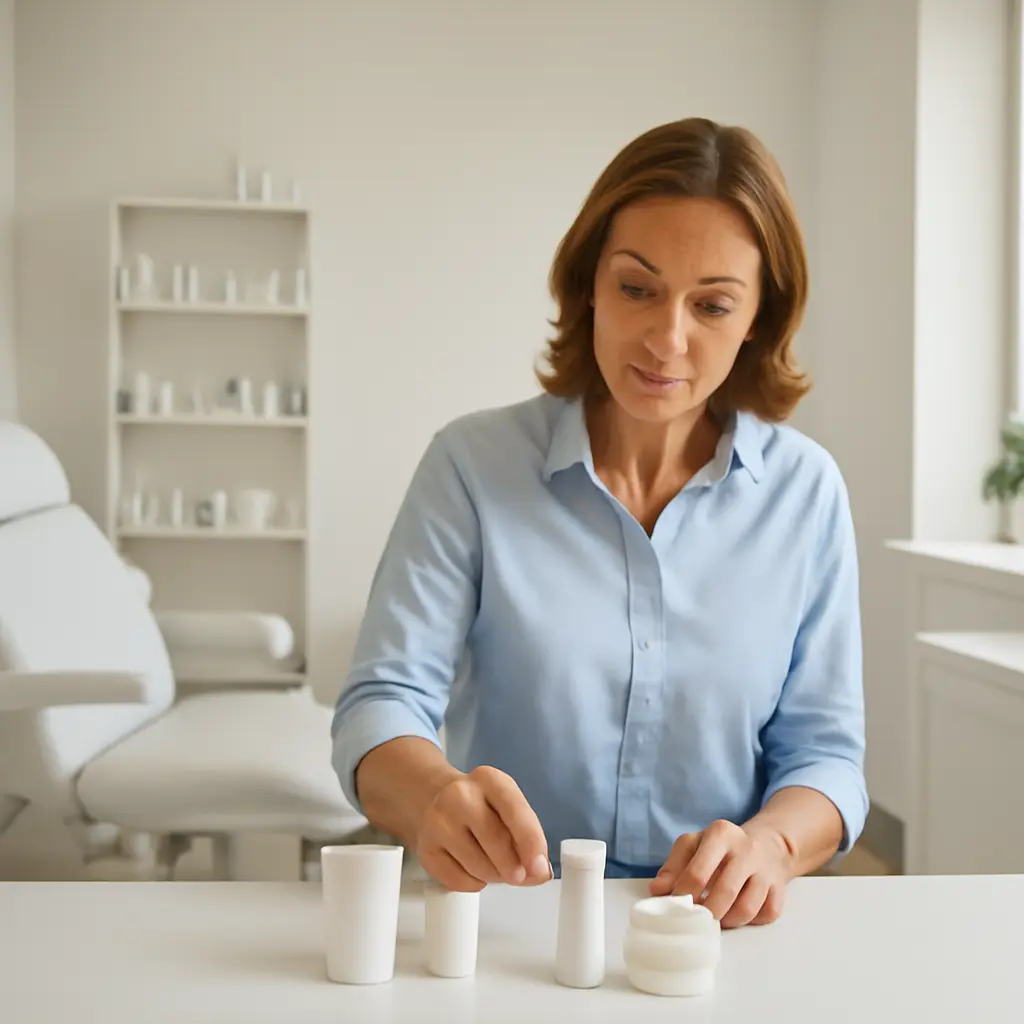
Calming ingredients in dermatologist-supervised clinical facials are topical substances selected to reduce irritation, support the skin barrier, and help skin tolerate treatment. Common choices include colloidal oatmeal, ceramides, glycerin, panthenol, and niacinamide, though the best option depends on the person’s skin condition, the facial’s active ingredients, and the clinician’s assessment. These ingredients matter because procedures and exfoliating products can temporarily increase sensitivity; the American Academy of Dermatology (AAD) advises gentle skin care after procedures such as chemical peels, while clinical reviews describe moisturizers and barrier-supporting ingredients as useful parts of managing irritation. Knowing what these ingredients do—and what they cannot do—helps patients have safer, more informed conversations with their dermatologist.
How calming ingredients support skin during clinical facials
A “calming ingredient” is a practical skin-care description, not a single standardized medical category. Dermatologists generally assess ingredients by their intended effects, such as reducing dryness, supporting the skin barrier, or easing sensations associated with irritation. The American Academy of Dermatology recommends choosing gentle, fragrance-free products for sensitive skin and using moisturizer to help maintain skin comfort. In a clinical facial, a calming product may be used before or after exfoliation, extraction, or another treatment, but the clinician should select it according to the procedure and the patient’s skin history.
The skin barrier includes the outermost layer of skin and its lipid-and-cell structure, which helps limit water loss and protect against external irritants. A facial that includes acids, retinoids, or physical exfoliation can be poorly tolerated by some people, especially when their barrier is already compromised. Calming ingredients therefore serve several related purposes: hydration, barrier support, reduction of avoidable irritant exposure, and improved comfort. They are not substitutes for diagnosing rosacea, eczema, allergic contact dermatitis, or other conditions.
Barrier-supporting ingredients
Ceramides are lipids naturally found in the outer skin barrier. Topical moisturizers containing ceramides are used to supplement barrier care and reduce dryness; glycerin is a humectant that attracts and retains water in the outer skin. These ingredients are often paired in moisturizers because hydration and barrier support address different aspects of skin comfort. Their inclusion does not guarantee that a product will suit every patient: the full formula, including fragrance and preservatives, can influence tolerance.
Soothing and water-binding ingredients
Colloidal oatmeal is finely milled oatmeal used in topical products to soothe and moisturize dry, irritated skin. The U.S. Food and Drug Administration recognizes colloidal oatmeal as an over-the-counter skin-protectant active ingredient when used in compliant products. Panthenol, also called provitamin B5, is used as a humectant and skin-conditioning ingredient. These products may help with dryness or tightness, but they do not replace medical treatment for a persistent rash, infection, or allergic reaction.
Niacinamide and other multi-purpose ingredients
Niacinamide, a form of vitamin B3, is used in skin-care products for barrier support and other skin-conditioning purposes. Some research has examined its role in improving signs associated with inflammation and barrier disruption, but evidence varies by formulation, concentration, and condition. A dermatologist may recommend it as part of a broader routine, yet it can still irritate some individuals. When a patient has reactive skin, introducing one new product at a time makes it easier to identify a trigger.
How dermatologists choose calming ingredients for a facial
Ingredient selection is guided by the patient’s skin condition, treatment plan, and known sensitivities—not by a universal “best calming ingredient.” A dermatologist or qualified clinical provider may ask about eczema, rosacea, allergies, current medicines, recent procedures, and products such as retinoids or exfoliating acids. The clinician also considers whether the facial includes a peel, extractions, or other steps that could increase irritation. This assessment helps determine whether to simplify the treatment, use a bland moisturizer, or postpone the facial.
Sensitive or reactive skin
For sensitive skin, fragrance-free and relatively simple formulas are often preferred because fragrance is a common source of contact allergy and irritation. “Unscented” does not always mean fragrance-free: a product can contain masking fragrance. Patients with a history of reactions should tell the clinician what caused them and may benefit from a patch test when allergy is suspected. The AAD recommends stopping a product that causes a reaction and seeking medical advice for significant or persistent symptoms.
Acne-prone skin
Acne-prone skin may need a moisturizer that supports comfort without adding an unsuitable, heavy product to the routine. “Non-comedogenic” labeling can help guide selection, although it does not guarantee that a product will not cause breakouts for an individual. A calming facial should not be treated as a replacement for evidence-based acne care. The provider should also consider whether exfoliation or extractions could aggravate inflamed lesions.
Rosacea, eczema, or a disrupted barrier
When rosacea, eczema, or active dermatitis is present, reducing triggers and protecting the skin barrier may take priority over cosmetic exfoliation. Heat, friction, fragrance, and harsh cleansing can worsen symptoms in some people. The National Rosacea Society advises patients to identify individual triggers and use gentle skin care; the National Eczema Association similarly emphasizes moisturizing and avoiding known irritants. A clinician may modify or defer a facial during a flare rather than trying to calm it with a cosmetic product alone.
Using calming ingredients safely before and after treatment
The product’s timing matters as much as its ingredient list. Before a facial, patients should disclose prescription and nonprescription skin products, recent sun exposure, allergies, and recent procedures. After a peel or other treatment, follow the provider’s aftercare instructions rather than adding several new products. The AAD notes that recovery guidance depends on the depth and type of chemical peel; deeper treatments require more extensive care and supervision.
- Choose products labeled fragrance-free when fragrance sensitivity is a concern.
- Introduce unfamiliar products gradually, and avoid layering several new actives at once.
- Use a gentle cleanser and moisturizer as advised; do not scrub skin that feels tender or is peeling.
- Follow the clinician’s directions about sun protection and when to restart retinoids, acids, or other active products.
- Seek medical advice for severe burning, swelling, blistering, worsening redness, or symptoms that persist.
A useful way to visualize ingredient selection is a simple decision chart: first identify the main concern—dryness, sensitivity, acne, or a diagnosed inflammatory condition—then review allergies and the planned procedure, and finally select a compatible product and aftercare plan. The chart is a discussion aid, not a substitute for an examination or a patch test when allergy is suspected.
Conclusion: choosing calming ingredients with clinical guidance
Calming ingredients in clinical facials are best understood by what they do: ceramides and moisturizers support the barrier, glycerin and panthenol help with hydration, colloidal oatmeal can soothe dry skin, and niacinamide may suit some routines. Dermatologists select products according to skin history and treatment intensity, while fragrance-free, gentle care and careful aftercare can reduce avoidable irritation. Before booking a facial, share your diagnoses, allergies, medicines, and current products; ask what will be applied and how to care for your skin afterward. For persistent or severe symptoms, consult a medical professional rather than relying on a facial product.
Sources: American Academy of Dermatology Association, How to care for your skin after a chemical peel, https://www.aad.org/public/cosmetic/younger-looking/chemical-peels-aftercare; American Academy of Dermatology Association, How to test skin care products, https://www.aad.org/public/everyday-care/skin-care-secrets/routine/product-testing; U.S. Food and Drug Administration, OTC Monograph M016: Skin Protectant Drug Products for Over-the-Counter Human Use, https://www.fda.gov/drugs/over-counter-otc-nonprescription-drugs/otc-monographs; National Rosacea Society, Skin Care & Cosmetics, https://www.rosacea.org/patients/skin-care-and-cosmetics; National Eczema Association, Skin Care, https://nationaleczema.org/eczema/skin-care/.